
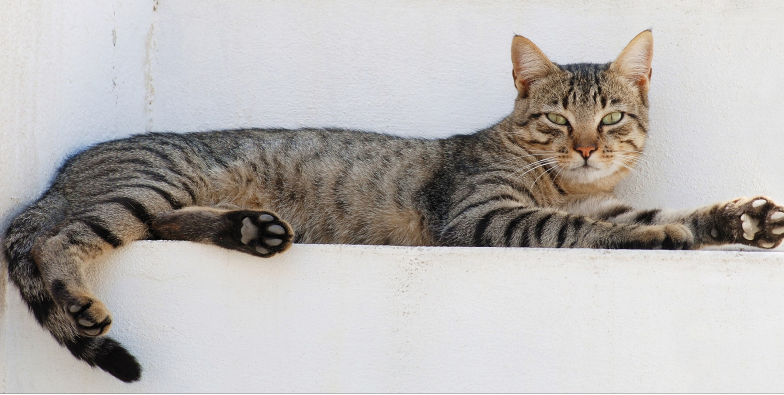
Cat
Small domesticated carnivorous animal
This article is about the species commonly kept as a pet. For the cat family, see Felidae. For other uses, see Cat (disambiguation) and Cats (disambiguation).
The cat (Felis catus), also referred to as the domestic cat or house cat, is a small domesticated carnivorous mammal. It is the only domesticated species of the family Felidae. Advances in archaeology and genetics have shown that the domestication of the cat occurred in the Near East around 7500 BC. It is commonly kept as a pet and working cat, but it also ranges freely as a feral cat, avoiding human contact. It is valued by humans for companionship and its ability to kill vermin. Its retractable claws are adapted to killing small prey species such as mice and rats. It has a strong, flexible body, quick reflexes, and sharp teeth, and its night vision and sense of smell are well developed. It is a social species, but a solitary hunter and a crepuscular predator. Cat communication includes meowing, purring, trilling, hissing, growling, grunting, and body language. It can hear sounds too faint or too high in frequency for human ears, such as those made by small mammals. It secretes and perceives pheromones. Cat intelligence is evident in its ability to adapt, learn through observation, and solve problems. Female domestic cats can have kittens from spring to late autumn in temperate zones and throughout the year in equatorial regions, with litter sizes often ranging from two to five kittens. Domestic cats are bred and shown at cat fancy events as registered pedigreed cats. Population control includes spaying and neutering, but pet abandonment has exploded the global feral cat population, which has driven the extinction of bird, mammal, and reptile species. Domestic cats occur across the globe, though their popularity as pets varies by region. Out of the estimated 600 million cats worldwide, 400 million reside in Asia, including 58 million pet cats in China. The United States leads in cat ownership with 73.8 million cats. In the United Kingdom, approximately 10.9 million domestic cats are kept as pets.
Senses
Vision
Cats have excellent night vision and can see at one sixth the light level required for human vision.[53]: 43 This is partly the result of cat eyes having a tapetum lucidum, which reflects any light that passes through the retina back into the eye, thereby increasing the eye's sensitivity to dim light.[68] Large pupils are an adaptation to dim light. The domestic cat has slit pupils, which allow it to focus bright light without chromatic aberration.[69] At low light, a cat's pupils expand to cover most of the exposed surface of its eyes.[70] The domestic cat has rather poor color vision and only two types of cone cells, optimized for sensitivity to blue and yellowish green; its ability to distinguish between red and green is limited.[71] A response to middle wavelengths from a system other than the rod cells might be due to a third type of cone. This appears to be an adaptation to low light levels rather than representing true trichromatic vision.[72] Cats have a nictitating membrane, allowing them to blink without hindering their vision.
Hearing
The domestic cat's hearing is most acute in the range of 500 Hz to 32 kHz.[73] It can detect an extremely broad range of frequencies ranging from 55 Hz to 79 kHz, whereas humans can only detect frequencies between 20 Hz and 20 kHz. It can hear a range of 10.5 octaves, compared to about 9 octaves for humans and dogs.[74][75] Its hearing sensitivity is enhanced by its large movable outer ears, the pinnae, which amplify sounds and help detect the location of a noise. It can detect ultrasound, including ultrasonic calls from rodent prey.[76][77] Research has shown that cats have socio-spatial cognitive abilities to create mental maps of familiar people's locations based on hearing their voices.[78]
